Every Person Born Is a Shareholder of the Commons
The economy runs on three shared foundations. None of them appear on the bill.
The Three Commons
Three categories of shared wealth that every company on Earth depends on. None has ever been properly invoiced.
Earth — The Finite Ground
The atmosphere is not a dump. The ocean is not a factory floor. The electromagnetic spectrum is not a free-for-all. But we have priced them as if they were.
Minerals in the ground, freshwater aquifers, ancient forests, orbital slots above the planet — these are finite. They accumulated over billions of years. No corporation created them. Every corporation that uses them is making a withdrawal from an account held in all our names.
A royalty on Earth use is not a new idea. Carbon pricing already does this, imperfectly. Spectrum auctions do this, partially. We need to extend the logic to every finite shared input — and route the proceeds to everyone.
“Atmosphere, oceans, minerals, forests, spectrum, orbital slots. Finite. Shared. Used as if they were free.”

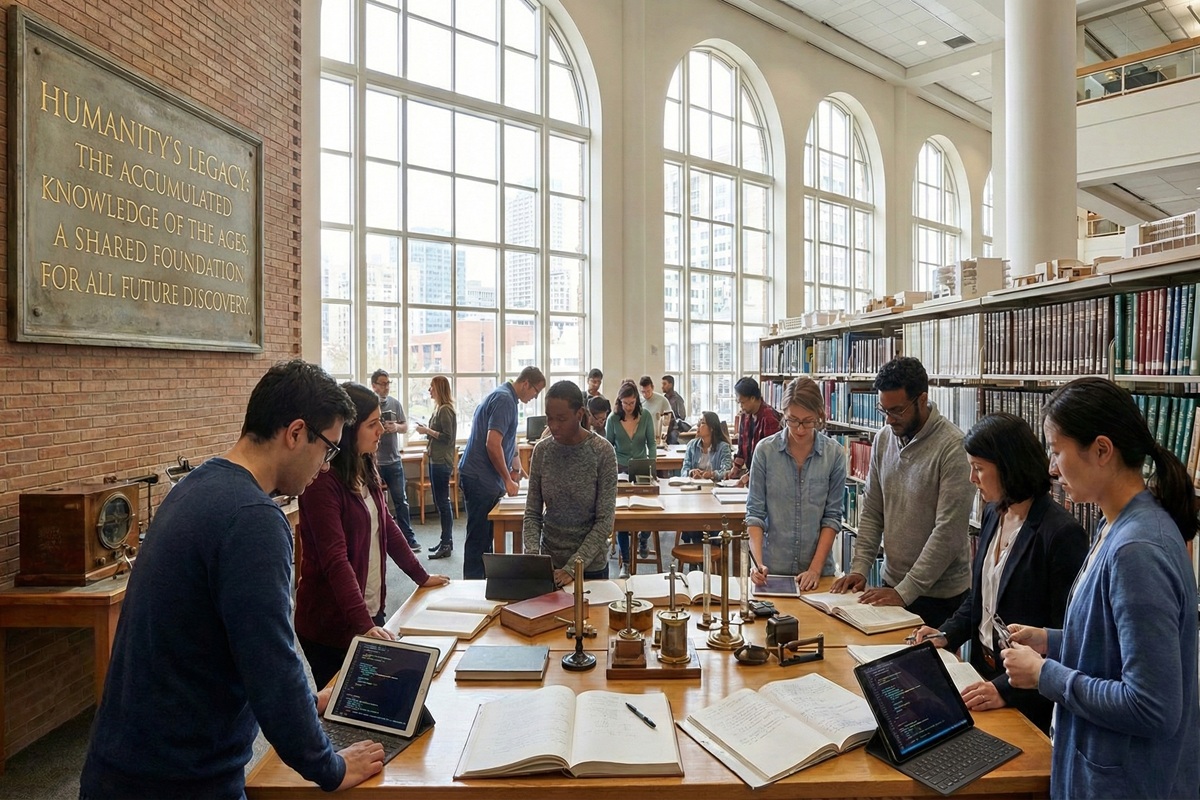
Light — The Inherited Knowledge
Every piece of technology in existence stands on top of publicly funded research. The internet came from ARPANET. mRNA vaccines depend on decades of publicly funded biology. GPS was a military project. Lithium-ion batteries were developed in university labs.
Mathematics, physics, chemistry, medicine — the entire body of human knowledge was built collectively over centuries, passed down through public institutions, and is now largely available to all. When a company uses calculus to price derivatives, or uses CRISPR (discovered at UC Berkeley) to build a biotech product, it is using the commons.
Open-source software — Linux, Python, TensorFlow — worth trillions in aggregate, was built by volunteers contributing to a shared pool. No royalty was ever paid to that pool.
“Science, mathematics, open-source code, medical research, engineering standards. Built over centuries by humanity. Inherited by all.”
Signals — The Intimate Patterns
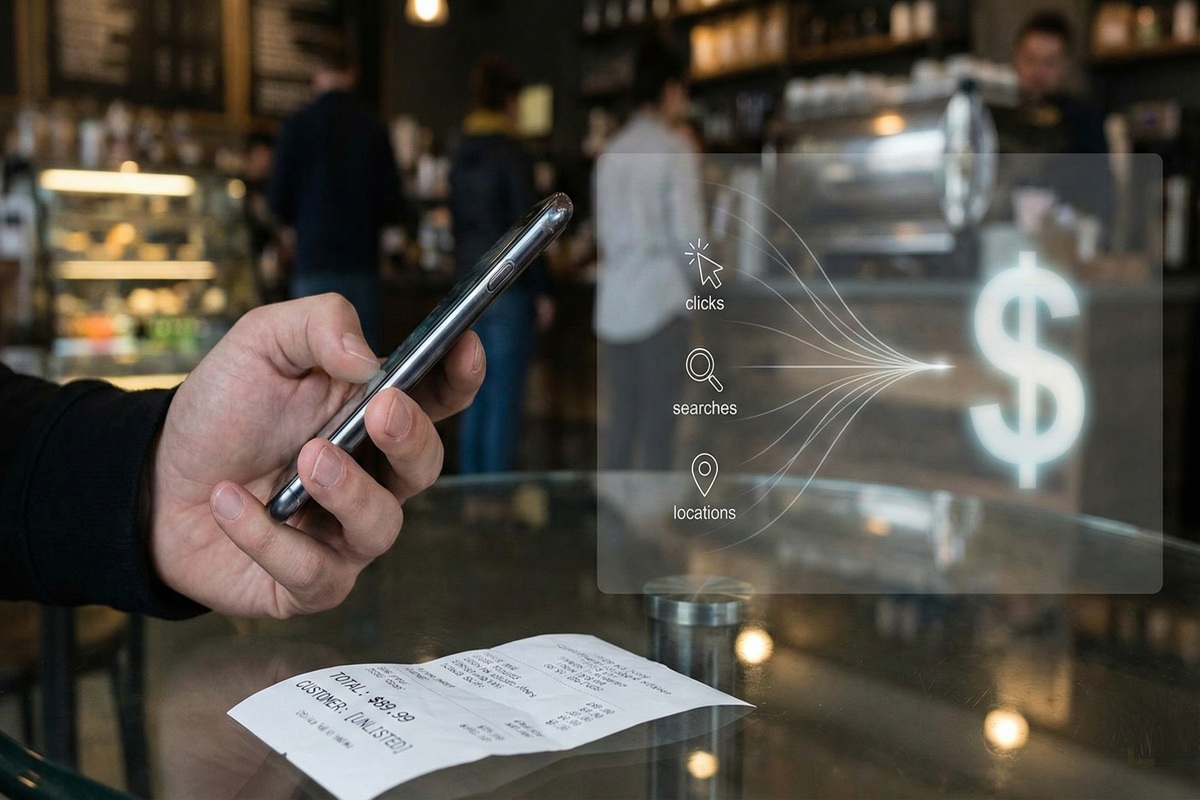
The third commons is the newest and most intimate. Your clicks, searches, purchases, location history, attention patterns, sleep cycles, relationships — collectively, this behavioral data is the raw material for the most valuable algorithms ever built.
The business model is straightforward: give you a free service, collect your behavior, train models on the aggregate, sell the predictions. The invoice for your phone listed a hardware price. It did not list you. You are a supplier who was never compensated.
When billions of people contribute their behavioral patterns to a platform’s training set, they are contributing to a shared pool of value. A data royalty — proportional to how intensively a platform uses behavioral data — returns a portion of that value to its rightful beneficiaries: everyone.
“Clicks, searches, purchases, movements. Your data trains algorithms worth billions. The invoice for your phone listed a price. It did not list you.”
The Missing Invoice
The market is very good at printing receipts. It prints them for shareholders, employees, landlords, and lenders. But it has never printed one for the commons.
This is not an accounting oversight. It is a structural feature of how capitalism evolved: private gains were organized early, common costs were left unorganized. The atmosphere had no lawyer. The knowledge commons had no invoice department. Your behavioral data had no labor union.
The result is that every balance sheet in the world is incomplete. It shows what a company paid for its inputs — labor, capital, land — but not what it drew from the shared foundations: the atmosphere it used as a free dump, the publicly funded research it commercialized, the behavioral data it collected without payment.
must benefit all.”
The principle behind the commons dividend.
The Fix: Four Gates, One Fund, One Dividend
No new world government required. Royalties collected at four existing checkpoints that every large company already passes through.
Gate 1: Customs
Every import/export manifest already exists. Adding a commons intensity line — a royalty proportional to how much Earth, Light, or Signals the product embodies — requires one new field, not a new agency.
Gate 2: Exchanges
Securities exchanges already collect fees. A commons-weighted micro-levy on trades in companies above a commons intensity threshold routes a small fraction of financial flows to the fund.
Gate 3: Licenses
Spectrum licenses, mineral extraction rights, pharmaceutical patents that rely on public research — all already require government approval. That approval can include a commons royalty component.
Gate 4: Platforms
Digital platforms are already regulated in most jurisdictions. A data royalty — calculated on the volume and intimacy of behavioral data used — is technically measurable and legally enforceable.
The Flow
Earth, Light, Signals
At the four gates
Commons dividend fund
Monthly dividend
It Already Works, In Parts
Every piece of the mechanism has been proven somewhere. What’s missing is applying them together, at scale.
Alaska Permanent Fund
Since 1982, every Alaskan resident receives an annual dividend from oil revenues. In 2022 it was $3,284 per person. The principle — shared resource, shared dividend — works. It just needs to be expanded beyond one state and one resource.
Carbon Pricing
Over 70 carbon pricing systems exist worldwide, generating $100B+ annually. Pricing the atmosphere is no longer theoretical. It is policy in the EU, Canada, the UK, and dozens of other jurisdictions.
Spectrum Auctions
Governments have auctioned electromagnetic spectrum rights for decades. The US alone has raised over $200 billion. We already know how to price and allocate a shared commons — we just don’t return the proceeds to everyone.
Switzerland’s Sovereign Wealth
Norway, Singapore, and others manage sovereign wealth funds for their citizens. The architecture exists. The question is whether to extend it to the full commons and open it to everyone on Earth, not just citizens of resource-rich states.
What Changes When Everyone Gets a Dividend
Dignity Without Dependency
A dividend based on shared benefit is not welfare. It does not come with conditions, bureaucracy, or stigma. It is yours because you were born here.
Freedom by Design
When your basic floor is secured by shared benefit rather than employment, you negotiate from a different position. Collective bargaining, entrepreneurship, and leaving bad situations all become more possible.
Privacy as Default
When platforms pay for the data they use, the incentive to over-collect disappears. A data royalty transforms surveillance capitalism into something closer to fair exchange.
Honest Accounting
When the commons appears on the balance sheet, corporate strategy changes. Companies that use fewer commons inputs get a competitive advantage. The externalities get priced in.
AI Without the Panic
Automation displaces workers, but the commons dividend does not depend on employment. As machines inherit more work, the dividend rises with productivity rather than threatening workers.
Global Without a World Government
The mechanism works through existing trade, financial, and regulatory infrastructure. Adoption can start at the city level and expand. No new supranational body required.
The Complete Library
Every essay behind the argument, organized by theme. Start anywhere.
Start Here — What It Means
The Three Commons: Earth, Light, Signals
The Funding Question
- The Funding Problem UBI Supporters Don’t Talk About
- The Missing Invoice: A Better Way to Pay for UBI
- The UBI Funding Math Everyone Avoids
- Spectrum Auctions Raised Over $233 Billion: A Real-World Funding Model
- Carbon Pricing Is Already Rent on the Atmosphere — Where’s the Dividend?
- Alaska’s Permanent Fund: The One Proof Everyone Ignores
What the Evidence Shows
Ready to read the full argument?
A Founding Shareholder is someone who joins before the framework is adopted. A statement of belief that every person born deserves their share.
Free first chapter included.