Every time a company announces an AI that replaces workers, the same loop starts. People will lose jobs. We need Universal Basic Income. Give everyone cash so nobody starves while the robots take over.
The fear is real. The loop is stuck.
It is stuck because the debate never leaves the surface. AI takes jobs, therefore give people money. But why? Because they’ll be poor? That is emergency relief. Because they’re human? That is an assertion no legislature can defend past one election cycle. The automation-to-UBI pipeline has the same problem UBI always has: no foundation under the claim.
The question worth asking is not who gets paid when the machines work. It is who owns what the machines are made of.
What the Machines Run On
Every large AI system was trained on the accumulated output of human knowledge. Scientific papers, open-source code, engineering standards, medical literature. Centuries of publicly funded research absorbed in weeks. Then refined by us: our clicks, searches, corrections, conversations, labeled images. Then run on the earth: rare minerals in the chips, electricity and water in the data centers.
Inherited knowledge. Behavioral data. Physical resources. These are not incidental to AI. They are AI. Strip them away and there is no model, no output, no profit.
This matters because it changes what automation actually does to the economy.
The Line That Keeps Falling
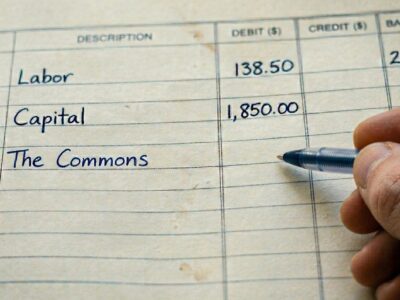
Economists track the share of economic output that goes to workers as wages versus owners as profit. In most advanced economies, that share has been falling since the 1980s. AI bends the curve harder. When a machine does what a person did, the wage does not disappear. It transfers. From the labor column to the capital column. The work still gets done. The person is no longer needed.
The standard answer is retraining. Learn new skills. The problem with AI specifically is that it automates the learning of new tasks. A factory robot does one thing. An AI system can be retrained overnight. Workers retrain for a new field. The AI follows them there before they finish the program. You cannot outrun a system that learns faster than you do.
I have picked up new skills several times — logistics, sales, marketing, writing, customer success, building software with AI. Not because I was forced. Because I was curious. Learning is good. Mandating it as the only means of survival and answer to automation is not.
So if wages shrink, retraining can’t keep up, and UBI has no foundation, what holds?
A Floor That Grows With the Machines
A commons dividend, funded by royalties on the three inputs AI actually uses, does not just survive automation. It gets stronger. As AI replaces labor, it does not stop needing inherited knowledge, behavioral data, and physical resources. It needs more. More training data. More compute. More minerals. More electricity. The royalty base expands in direct proportion to the force displacing workers.
A minimum wage cannot help you if there is no job. A retraining program cannot help you if the field automates before you graduate. A tax-funded UBI weakens when automation shrinks employment and the tax base shrinks with it. The funding dries up exactly when people need it most.
A commons dividend does the opposite. The more productive the machines get, the more commons they consume, the larger the royalty, the larger the dividend. The force that threatens livelihoods funds the thing that protects them.
No other framework does that. Not because other frameworks are cruel. Because they tied income to employment, and employment is the thing that’s breaking.
Survival Without a Job Title
The commons dividend does not require you to have a job, lose a job, or prove you’re looking for one. It does not care if you retrain or rest. It tracks what the economy uses, not what you do. As long as companies extract resources, build on inherited knowledge, and harvest behavioral data, the royalty flows and the dividend pays.
That is not a safety net thrown after you fall. It is a stake you hold while standing. The economy runs on shared inputs. The return on those inputs arrives in your account every month whether you are employed, unemployed, or building something nobody has named yet.
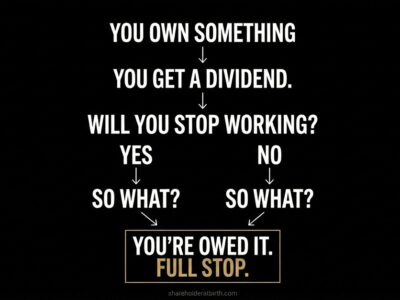
UBI says: automation is scary, here’s cash. The commons dividend says: automation runs on your stuff, here’s your share.
One depends on political will. The other depends on the economy existing.